
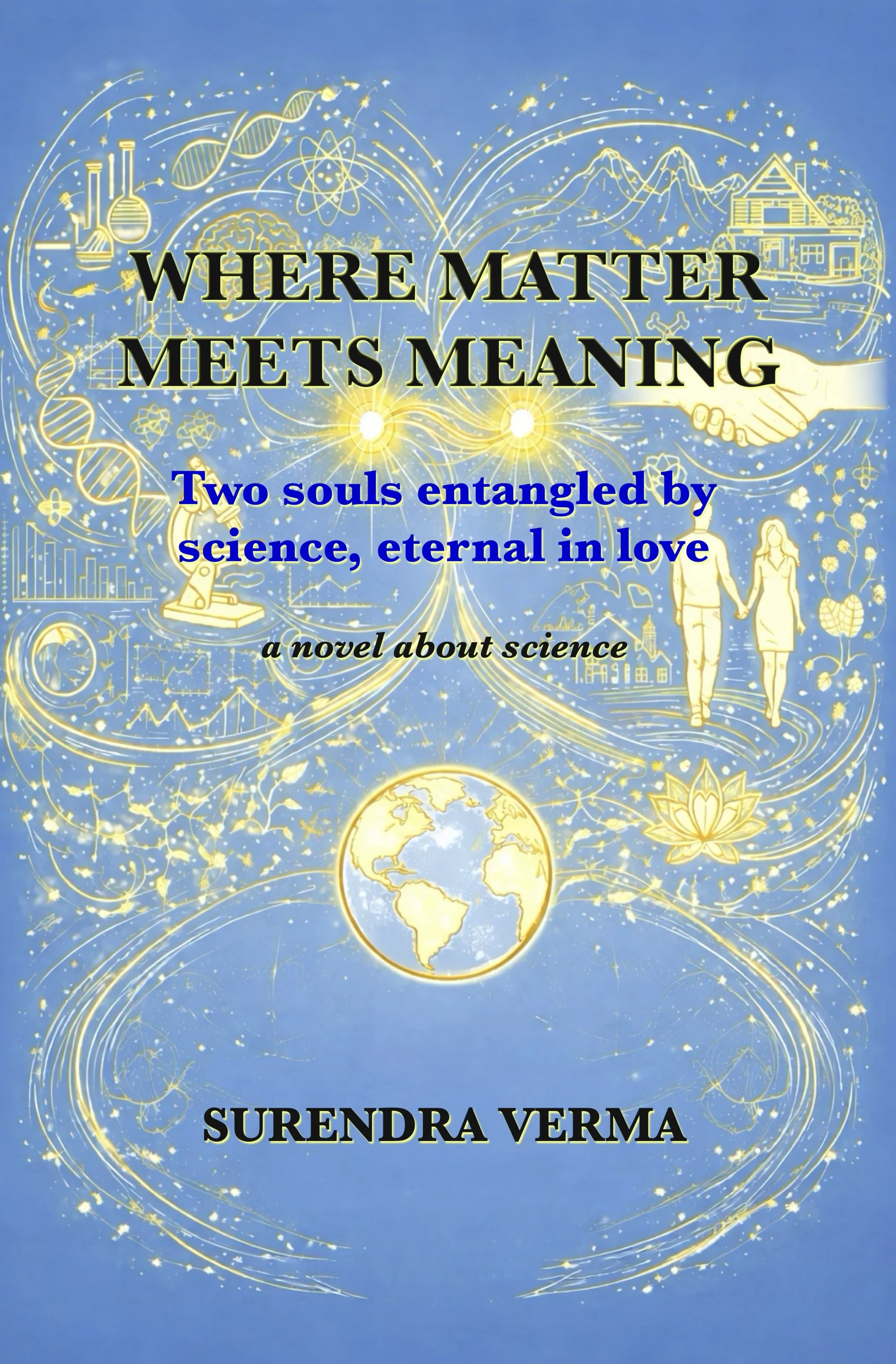
AN EXCERPT
Once, scientists believed the universe could be explained by laws, equations and predictions. Then they encountered entanglement.
Two particles. One connection. No distance too great.
When two strangers meet, they expect only coincidence. Instead, their lives become intertwined in ways neither can fully understand. Their relationship develops alongside a changing scientific perspective—one that shifts from classical determinism to quantum probability, in which uncertainty reflects not ignorance but structure.
As science shifts from classical certainty to quantum unpredictability, their personal journey mirrors a deeper human quest for meaning in a world that defies simple answers. Through research, doubt, ambition, and loss, they confront the limits of knowledge—and the quiet hope that love may endure where certainty cannot.
A story of ideas, consequences and connection.
Kindle, paperback and hardback editions are available from Amazon; the Audible edition is available in the US only.
Chapter 5. Following the lanterns that lost their strings
The storm had been circling the city for hours, its thunder roaring like a hundred cannons firing at once. Anaya stood by a window, watching the sky split into jagged veins of light. She wasn’t afraid; to her, storms had always felt like conversations—loud, unpredictable, yet sincere.
Then it arrived, not from above but from the ground. A sphere of light, a little bit larger than a melon, rose from the wet grass like a thought escaping the earth. Like a ghost lantern, it hovered, pulsing gently, as if it were breathing. Not fire. Not electricity. Something in between—a luminous wonder.
Anaya didn’t move. The sphere drifted towards her, slow and deliberate, casting shadows that danced like memories. It passed through the window without resistance, through the mist like a dream that refused to wake.
She remembered the stories her grandmother had told of wandering lights that visited the lonely, the curious, the cursed. She called them ‘the lanterns that forgot their string’; beacons without anchors, searching for something they’d lost.
Humming gently, the ball of lightning hovered before Anaya. She followed the orb. Then, with a sudden flicker, the free-floating, green-violet, luminous sphere moved along a road lined with trees in Geneva; the autumn air was crisp, and the leaves were golden. The sphere dived through a chimney and entered a room.
‘There you go,’ Anaya whispered to me, ‘your only chance to meet the men who throttled the progress of science.’
Holding Anaya’s hand and humming, ‘Forbidden truth is like forbidden love,’ I watch the drama with many acts.
~*~
26 October 1553. An hour before noon, at the centre of the room stands the accused, who has denied the Trinity (there is one God who eternally exists as three distinct persons: the Father, Son and the Holy Spirit). He is Michael Servetus, a Spanish theologian and physician, with a serious contemplative expression, dark wavy hair, sharp, angular features, a high forehead and a trimmed beard. Surrounding him are Geneva city magistrates; two other invisible orbs of theological dogma and civic law hover over their heads.
The magistrates pronounce the sentence for challenging the religious orthodoxy: Bind him, take him to the Plateau de Champel, and there tie him to a stake and burn him alive, his book to ashes.
A terrible silence follows the sentence read, and the staff is broken over the prisoner. He begs John Calvin, the formidable Protestant reformer and his chief accuser, to be allowed to die by the sword. Calvin refuses, saying that incendiary ideas must be extinguished in kind. Servetus replies that he prays to God to forgive his enemies and prosecutors.
The council wastes no time in carrying out the sentence.
On 27 October, a cold autumn day, a solemn procession winds through Geneva’s narrow, crowded streets. A priest walks by his side and tries to make him admit the errors of his heresy and blasphemy. He refuses to recant.
Finally, the procession reaches the hill at Champel, where the executioner has prepared a pile of green wood specifically designed to be hard to burn. He makes Servetus sit on the block, with his feet just touching the ground. The executioner then secures his body to the stake behind him with an iron chain and also fastens hemp ropes around his neck. Two copies of his book—a manuscript he had sent to Calvin and a later printed copy from Vienna—are attached to his waist, and his body is sprinkled with straw and green twigs.
The executioner applies the flame to the greenwood pile, and the flames flash in his face. The victim’s cry of anguish strikes terror into the surrounding crowd. He then sits in silent bravery, and after 30 excruciating minutes, he shows no further signs of life or suffering. Then he cries in agony, ‘Jesus, Son of the Eternal God, have mercy on me.’
A slow and torturous death of a man whose only crime was to pursue truth and scientific understanding.
His persistent claim that the Trinity was not described in the Bible angered both Catholics and Protestants. Servetus’s trial is a poignant reminder of the eternal struggle between dogma and discovery, and between belief and reason. But believing means never explaining why, and reason fails to behave reasonably when passions rule the mind.
In 1553, after practising medicine for 12 years, Servetus wrote a book, Restitutio Christanismi (Restoration of Christianity), in which he challenged certain false concepts about blood movement in the human body.
In the 16th century, many misconceptions about Galen, a renowned ancient Greek physician, still dominated medicine. Galen described an ebb-and-flow movement of the blood: during the ebb phase, the pulmonary artery conveyed blood from the right ventricle to the lungs, and during the flow phase, blood flowed from the left ventricle to the right ventricle. He further stated that the blood passed through the septum, the partition separating the right and left ventricles. In the left ventricle, blood was picked up—Galen believed, as in the Bible, God breathed into humans the breath of life or soul—the ‘vital spirit’ or air brought from the lungs by the pulmonary vein. In brief, the ‘vital spirit’ was received from the left side of the heart, which then pumped blood into the arteries.
Servetus dissented from this view. He said blood passes from the right ventricle through the long pulmonary artery to the lungs, where it mixes with the ‘vital spirit’ or air.
Servetus knew that his ideas might outlive him, but not his body.
~*~
The luminous ball was now hovering above another seeker of truth.
9 February 1600. It is freezing cold in Rome’s grand and ornate Hall of the Inquisition, a formidable institution that protects the Catholic Church's beliefs. In the darkness, flickering oil lamps cast long shadows across the stone walls. Fifteen distinguished cardinals of the Holy Office sit on high-backed plush chairs, forming an arc around the accused—a 51-year-old, small, thin man with black hair and deep brown eyes —who kneels silently. The Grand Inquisitor, Cardinal Severina, reads the charges.
The eight counts of heresy include blasphemy, immoral conduct, belief in the movement of the Earth, and an infinite universe filled with innumerable worlds that potentially harbour life. Cardinal Severina asked him to recant his beliefs and pray for God's mercy.
He speaks not to the judges, but to the cosmos, ‘The stars are suns. The universe is infinite. And truth is not bound by your beliefs.’
I feel the air thicken. This isn’t just a trial—it’s a metaphysical crucible. The judges accuse Bruno of heresy, but I see the deeper tension: not religion versus science, but dogma versus imagination.
The man remains silent. The cardinal excommunicates the heretic and sentences him to die ‘without shedding of blood’ (in other words, burn him alive at the stake).
The defiant man lifts his head and declares, ‘Perhaps you, my judges, pronounce this sentence against me with greater fear than I feel it. The time will come when all will see as I see.’
He is given eight days’ grace to recant and deny his beliefs, but his belief in the truth remains unshakable.
Eight days later, the man lies naked on a rack, his ankles and wrists tightly bound, in a dark, dreary, and damp dungeon in the terrible Tor di Nona prison in Rome, which has been his home for the past two years. In the feeble light of winter dawn, his guards ask him to put on the sulphur-coloured garb of heresy, covered with pictures of devils, crimson flames, and crosses.
On that chilly morning, he is led in chains through a howling, fanatical crowd to the site of the execution, a public square called the Campo de’ Fiori. He walks calmly and with dignity, his face serene, his head high. He is stripped naked, and a shirt of pitch that extends from his waist to his feet is put over him so that he will not die as quickly.
The executioner ties him to the stake, forces a gag in his mouth to silence his final words, piles firewood, charcoal and kindling up to the chin and places a torch between the feet. As the flames blaze around him, a priest pushes forward and presses a crucifix into his hands, but the man turns his head away. Within seconds, flames sear him, and smoke and fire surround him. In the fire, I see Anaya’s face silently urging me to show courage. A wave of possibility turned into a moment of connection.
When the fire subsides, his remains are powdered and blown in the wind so that no relic of the heretic would survive.
The flames consumed the body of Giordano Bruno, but the embers of his pyre became a spark that would ignite the flames of scientific enlightenment. In 1889, a statue in his honour was erected at the exact site where he was burned. The statue in Campo de’ Fiori, within walking distance of the Vatican, is now surrounded by a colourful and busy market.
Bruno, a cosmologist, philosopher and Dominican monk, was an ardent believer in the Copernican system. In 1543, Copernicus rejected the ancient and widely held belief that the Earth stood still at the centre of the universe and that the Sun revolved around it. On the contrary, he declared that the Moon revolved around the Earth and that the Moon and Earth revolved around the Sun. Bruno’s ideas went beyond Copernicus, as he proposed an infinite universe filled with innumerable worlds.
In 1584, Bruno published two important books, The Ash Wednesday Supper and On the Infinite Universe and the Worlds. The second book marked the beginning of his fatal dispute with the powerful and dogmatic Catholic Church, whose motto was ‘Do not examine, only believe.’
Bruno viewed the relations between God, the universe, and humans differently. In this view, humans were no longer at the centre of the universe, and their place in it became a minor episode in the history of an insignificant planet. The Church feared that Bruno’s view would undermine the concept of heaven lying just beyond the sphere of fixed stars and would be detrimental to the Catholic faith.
Bruno’s ideas, once considered heretical, now form the foundations of modern cosmology.
~*~
The luminous ball was now growing, surrounding another man in another dramatic trial.
22 June 1633. A summer day. Ten stern-faced cardinals of the Inquisition at Rome, each splendidly dressed in a scarlet cassock, a white surplice trimmed with lace, and a short-hooded cape fastened with pairs of buttons down the front, sit on exquisitely carved chairs behind a large table in the forbidding Hall of Inquisition. A frail, 70-year-old man dressed in a white gown of penitence kneels at the centre of the hall. He speaks in a soft, subdued voice:
I, Galileo Galilei, son of the late Vincenzio Galilei of Florence, aged 70 years, being brought personally to judgment … having before my eyes and touching with my hands the Holy Gospels, swear that I have always believed, do believe and by God’s help will in the future believe all that is held, preached and taught by the Holy Catholic Church ... I must altogether abandon the false opinion that the sun is the centre of the world and immovable and that Earth is not the centre of the world and moves and that I must not hold, defend, or teach in any way whatsoever, verbally or in writing, the said false doctrine ...
The great scientist is so convinced that Earth moves as he rises from his knees, stamps his foot on the ground, and mutters, ‘E pur si muove’ (‘And yet it moves’).
This public recantation brought an end to the most tragic trial in the history of science. Although saved from the Inquisition’s deadly dungeons when the Pope commuted his sentence, he was placed under house arrest for the rest of his life; his book was banned and added to the Index of Prohibited Books.
Galileo was the first to study the heavens through the telescope, which he independently invented in 1609 after hearing about a spyglass made by a Dutch spectacle-maker, Hans Lippershey. Everything he saw through his telescope convinced him that Copernicus was right. Earth and other planets spin on their axes and revolve around the sun in circular orbits. He concluded that dark ‘spots’ on the sun's surface appear to move; therefore, the sun must also rotate. He argued that the Moon’s craters and mountains, as well as sunspots, prove that the ancient theory of perfect heavenly spheres was incorrect.
Like Giordano Bruno, he believed that there might indeed be life on other planets. As a scientist, he was interested in the possibility of life on other planets but did not venture into the religious question of whether Christ had redeemed these extraterrestrial creatures.
In 1632, Galileo published his masterpiece, Dialogue Concerning the Two Chief World Systems, in which he eloquently defended and extended the Copernican system. Against the universal practice of his time to write on philosophical and scientific subjects in Latin, Galileo wrote in Italian, ‘because I wished everyone to be able to read what I wrote’.
In this book, whichmarked the transition from the dark days of the Middle Ages to the dawn of modern science, the dialogue features Salviati, a philosopher who represents Galileo’s views; Simplicio, a pedant who follows Aristotle; and Sagredo, an intelligent layman.
Simplicio: How do you deduce that it is not the earth, but the sun, which is at the centre of the revolutions of planets?
Salviati: Neither Aristotle nor you can prove that the earth is the de facto centre of the universe; if any centre may be assigned to the universe, we shall rather find the sun to be placed there. This is deducted from the most obvious and therefore most powerfully convincing observations.
Simplicio: Please, Salviati, speak more respectfully of Aristotle.
Salviati: Does not he say that a circular motion for the earth would be forced, and therefore not eternal? And that this is absurd, since the world order is eternal.
Sagredo: What kinds of things are the earth, the sun and the stars in nature? Are they trifling things or important?
Simplicio: They are principal bodies; most noble, integral parts of the universe.
Galileo’s views were thought to contradict the Church's teachings. A year later, he was tried for heresy by the Inquisition and forced to renounce his theories. Under the threat of torture, he agreed to ‘confess’, against his belief that ‘the Bible teaches us to go to heaven, not how the heavens go’.
~*~
The bright ball burst with a sigh. My face brightened. ‘So, it’s the end of these trials. The new age of enlightenment has begun; we no longer need to follow these balls of lightning, which your grandmother called lanterns that had forgotten their strings.’
I heard Anaya laughing, ‘You are wrong, as always.’
~*~
10 July 1925.It is a sweltering day in Dayton, an isolated town of 1800 in Tennessee, United States. Horse-drawn wagons, fitted with settees and chairs, and small Ford automobiles, especially built for Rocky Mountain roads, jam the dusty Market Street. The horde of visitors from nearby mountain farms has come to witness a bizarre evolution-creationism trial that has turned the tiny town into a carnival. Banners hang from buildings. Signs tied to the trees exhort sinners, ‘Read your Bible daily’ and ‘Be sure your sins will find you out’. Two blind minstrels sing mountain hymns of promises of reward for the weary and faithful. Stalls sell ‘Monkey Fizz’ lemonade, ‘Your Old Man’s a Monkey’ buttons and books for or against evolution.
There is a chimpanzee outside the courthouse that has been brought to the town to ‘testify’ against the defendant John Scopes, a twenty-four-year-old biology teacher at the Rhea County High School in Dayton, who had assigned his pupils a simple task: Reading five pages of a popular biology textbook dealing with evolution. He is charged with violating a State of Tennessee law that made it illegal ‘to teach any theory that denies the story of the Divine Creation of man as taught in the Bible, and to teach instead that man has descended from a lower order of animals.’
Scopes was not exactly teaching that humans evolved from monkeys. He was a pawn in the clash between science and religion in American society.
9 a.m. Visitors and local citizens (including over a hundred reporters from newspapers around the country) pack the hot and humid courtroom and overflow onto the well-kept lawns of the courthouse, shaded by maple trees. Judge J. T. Roulston empanels a jury of twelve men (one of them is unable to read), and the trial begins.
William Jennings Bryan, counsel for the prosecution, speaks in defence of revealed religion, as he and his followers believed, and introduces the Bible in evidence.
Clarence Darrow, counsel for the defence, paints the trial as ‘the first case of its kind since we stopped trying people for witchcraft … we cannot test every fact in science by religious dictum’. He exposes scientific inconsistencies in Bryan’s arguments, but Judge Roulston refuses to allow expert testimony on evolution.
Another attorney, Arthur Garfield Hays, argues that John Scopes deliberately broke the recently passed law, ‘to show results in hate and intolerance, that they are conceived in bigotry and born in ignorance—ignorance of the Bible, of religion, of history, and science.’
11 July.The New York Times headlines on the front page: Cranks and Freaks Flock to Dayton. Strange Creeds and Theories Are Preached.
21 July. After two weeks of testimony and arguments between the prosecution (‘If evolution wins, Christianity goes’) and the defence (‘Scopes isn’t on trial; civilisation is on trial’) and eight minutes of deliberations by the jury, Scopes is found guilty and fined $100.
After pronouncing the sentence, Judge Roulston exclaims, ‘Oh, have you anything to say, Mr Scopes, as to why the Court should not impose punishment on you?’
Carrot-coloured-haired, boyish-looking Scopes replies in a trembling voice, ‘Your Honour, I feel that I have been convicted of violating an unjust statute. I will continue in the future, as I have in the past … to teach the truth, as guaranteed in our Constitution, of personal and religious freedom. I think the fine is unjust.’
The court session ends with a burst of laughter when Judge Roulston happily accepts an assistant defence counsel’s offer, ‘May I ask Your Honour to allow me to send you On the Origin of Species and The Descent of Man by Charles Darwin?’
In July 1926, the Tennessee Supreme Court overturned the verdict and dismissed the charges, concluding, ‘Nothing is to be gained by prolonging the life of this bizarre case.’
The Tennessee law was repealed in 1967. John Scopes left Dayton shortly after the verdict and became a geologist for mining companies. He died in 1970, outliving the law he was convicted of violating.
After 80 years, evolution was again challenged in a US court. In 2004, the Dover Area School District in Pennsylvania directed teachers to preface instruction on evolution with a disclaimer stating that evolution is not a fact. After a 40-day trial comparing evolution with Intelligent Design (ID), the court ruled in 2005 that ID is not a scientific theory but a repackaged form of creationism, and that the district could not require teachers to denigrate or disparage the scientific theory of evolution.
However, in the US, the debate over evolution’s place in public education continues today.
~*~
Did it all really happen? To soothe my mind, I’m now singing a verse written in about 1712 by English poet Richard Blackmore. Anaya appears and joins me. As I put my hand on her shoulder, there is nothing there. A quantum shadow, again!
Copernicus, who rightly condemned
This eldest system, form’d a wiser scheme;
In which he leaves the sun at rest, and rolls
The orb terrestrial on its proper poles;
Which makes the night and day by this career,
And by its flow and crooked course the year.
However, the shadow reminds me that in 1530, Nicolaus Copernicus completed a book, De Revolutionibus Orbium Coelestium (‘On the Revolutions of the Celestial Spheres’), which challenged the dogma that the Earth stood still at the centre of the universe and proposed a new theory of a sun-centred universe.
Copernicus had found the truth, but convincing the world of it was an onerous task. He did not publish his findings because they were thought to contravene the teachings of the Catholic Church. Religious leaders of his time were against him. Martin Luther (founder of the Lutheran Church in Germany) denounced him as ‘a new astrologer’ … ‘the fool’ who wanted ‘to overturn the entire science of astronomy’.
In 1543, Copernicus’s pupil and friend, Georg Rheticus, took the manuscript to Nuremberg and oversaw the printing of about 600 copies. A copy was sent to the author, but it arrived only a few hours before his death and was placed on his deathbed. As a result, the greatest astronomer of his era died without seeing his book in print.
Copernicus’s book, which ranks alongside Newton’s Principia and Darwin’s Origin of Species as a work of scientific genius, laid the foundations of modern astronomy.
© Surendra Verma 2026